

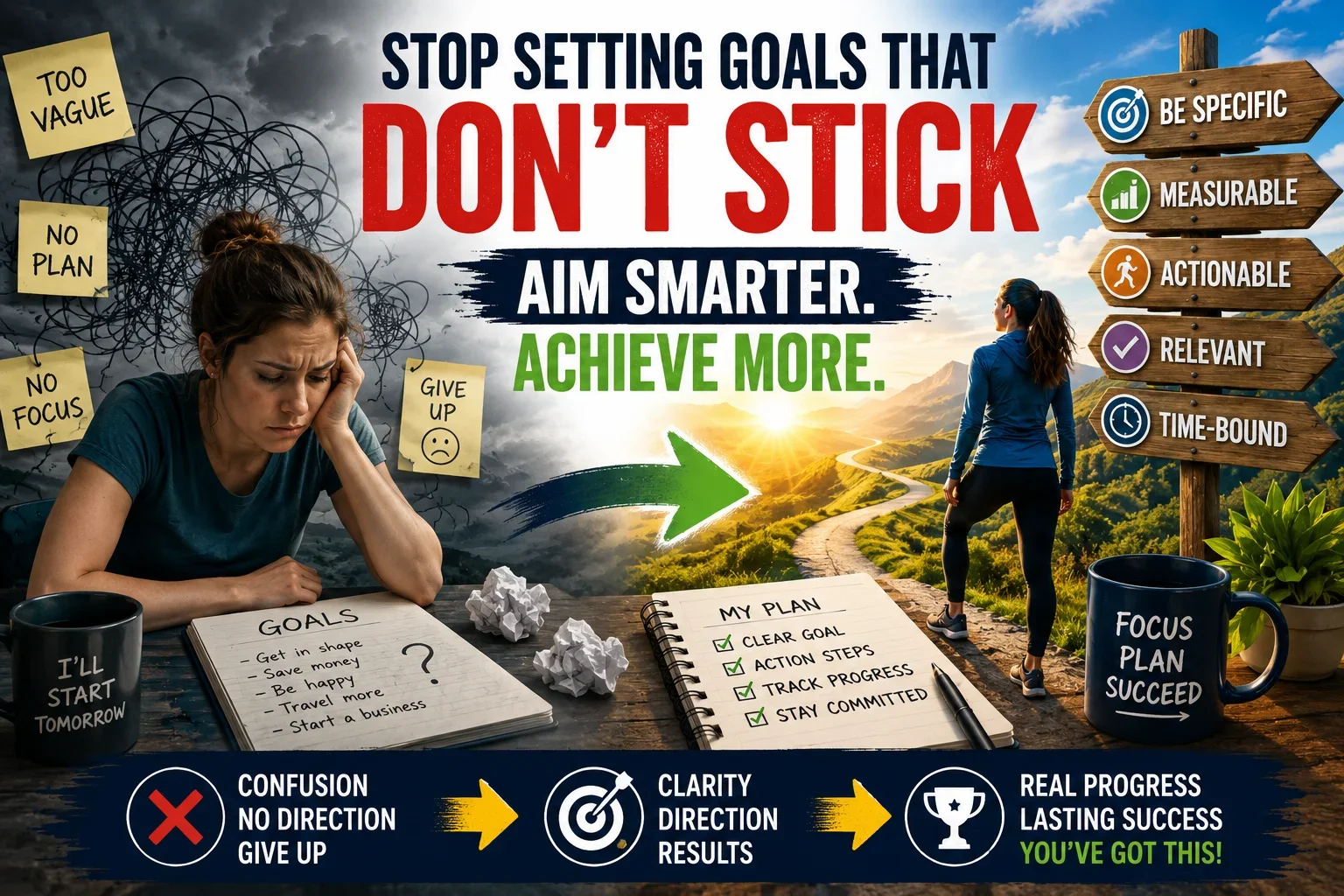
Have you ever felt frustrated after setting goals that just don’t stick? Vague goals often lead to confusion and disappointment. Understanding why goals fail can change everything—helping you set clear targets that inspire real progress and lasting success. Let’s explore how to aim smarter.
Why goals fail despite your best intentions
The hidden psychology behind vague goal setting
The critical paradigm shift: focusing on habits and systems over outcomes
Practical frameworks to convert aspirations into daily actions
Actionable examples and routines to replace vague goals
The Dopamine Trap: Why Setting Goals Feels Good but Leads Us Astray
The act of setting new goals brings a powerful feeling of hope and excitement. This is not just optimism—it’s a biological response. When we jot down a target or announce a new ambition, our brains release dopamine, the neurotransmitter that fuels motivation and pleasure.
This surge tricks us into feeling as though we’ve already accomplished something significant, simply by planning. It’s a mental shortcut: our brains equate envisioning progress with actual achievement.
However, this “dopamine trap” is a subtle saboteur lurking behind every list of New Year’s resolutions and Monday-morning promises. The satisfaction fades quickly because dopamine rewards intention, not execution. We feel productive just for planning instead of doing the hard work of follow-through.
This explains why our best intentions—no matter how ambitious—often run aground when real world friction (distractions, fatigue, uncertainty) sets in. Recognizing this pattern is the first step toward understanding why goals fail so consistently, even for highly motivated individuals.

The Science Behind Why Goals Fail to Produce Lasting Change
Research in behavioral psychology reveals that human brains are fundamentally wired to favor immediate, repeatable actions over distant, abstract outcomes. When a goal is vaguely defined—like “eat better” or “get fit”—it’s interpreted as a distant wish.
The problem is, our daily behaviors are guided by immediate cues and environmental triggers, not distant milestones. Because there’s no real structure connecting the intention to an actionable step, our brains slip into autopilot, reverting to old patterns and routines at the first sign of resistance or distraction.
Without a concrete system or habit in place, even the clearest ambition becomes subject to procrastination and self-justification. Genuine progress emerges from the small, frictionless steps you consistently repeat, not from grand visions scribbled in a journal.
This explains the paradox: the better and more exciting a goal feels at the start, the more likely it is to fail unless transformed into a sustainable action system. To create change that sticks, you must look beyond the dopamine rush of intention and start engineering your daily environment and triggers to support deliberate behavior.
It's also important to recognize how external factors, such as stress, can undermine your ability to follow through on even the best-designed habits. If you’re curious about how stress manifests physically and impacts your progress, you might find it helpful to explore key wellness insights on recognizing the signs your body is stressed and how they can subtly derail your routines.
As Psychology Today notes,
"If it’s too vague, you can’t monitor it”
— without a measurable target, people cannot tell whether they are moving forward, falling behind, or what to change.
Understanding Vague Goal Syndrome: Why Goals Fail and What Actually Stops Progress
So, what actually stops us from achieving our goals? The main culprit is often not a lack of ambition or motivation but “Vague Goal Syndrome”—the tendency to set targets that lack specific actions or measurable markers.
These goals feel satisfying and aspirational when you state them, but because they don’t translate into clear behaviors, they offer little guidance when challenges arise. The brain gets stuck in planning mode, mistaking the comfort of intention for the discomfort of doing.
This syndrome allows us to excuse inaction by hiding behind the hope that “progress will happen” if we just keep wishing for it. Vague goals also make it easy to rationalize failure: it’s impossible to clearly define when you’ve succeeded or what you should do next. As a result, progress stalls, and excuses flourish. Addressing why goals fail requires exploring how the specifics—or lack thereof—in our intentions sabotage us at every twist and turn.
The Illusion of Progress: How Vague Goals Provide Easy Excuses
When your goals are unclear, your mind focuses on the feeling of desire rather than the structure of achievement. This illusion of progress is comforting: you tell yourself you’re working toward “being healthier” or “getting organized,” but these abstract ambitions don’t cue you into action. The absence of measurable steps means you can always defer effort—waiting for motivation, blaming your schedule, or claiming it’s not the right time.
This lack of definition gives you permission to quit or pause without guilt, since you never articulated where or how to start. In effect, vagueness acts as a built-in excuse: you’re never truly failing, because you never clearly defined what “winning” looked like. That’s at the very heart of why goals fail: it’s not missing the mark, but never drawing a mark in the first place.
Psychologist and author James Tartaglia summarizes a core finding from goal-setting research:
“Specific, hard-to-accomplish goals lead to better performance than easy or vague goals.”
Specificity turns an intention such as “get healthier” into behaviors that can be planned and tracked, such as walking 30 minutes five days per week. (PsychologyToday)
Common Pitfalls: Examples of Vague Goals That Consistently Fail
To move from frustration to consistent progress, begin by identifying common vague goals in your own life. These are the classic traps—enticing aspirations that lack any actionable pathway or metric for success. They create cycles of excitement followed by disappointment when, unsurprisingly, there’s nothing concrete to track or improve upon.
The opposite of a vague goal is a clearly delineated, input-focused habit. Here are three classic examples and their operational replacements:

“Get healthy” vs. “Walk 20 minutes after lunch every weekday”
“Be more productive” vs. “Turn off notifications from 9–11am and complete one task”
“Save money” vs. “Transfer $20 to savings every Friday”
The Paradigm Shift: From Outcome-Driven to Input-Driven Goal Setting
The real breakthrough that addresses why goals fail comes from shifting your entire perspective—from aiming at distant destinations to engineering your daily flow. This move from Outcome-Driven (destination-focused) thinking to Input-Driven (process-focused) systems changes how you interact with your ambitions.
Most people design goals by deciding where they want to end up. The flaw with “Destination Design” is that it overestimates the power of willpower and underestimates the influence of daily friction and environmental cues.
Success is not a result of one huge push, but a product of repeated behaviors stacked atop one another. “Friction Engineering” means designing your environment and routines so good choices are easy and repetition is automatic.
Destination Design vs. Friction Engineering: Where Most People Go Wrong
People naturally gravitate toward picturing an impressive end result—weight lost, money saved, skills acquired—without actually mapping the tiny behaviors required to get there each day.
Destination design feels satisfying but relies on brute force and hope. Those who consistently achieve their goals are not necessarily more disciplined; they are better at removing friction, making critical inputs nearly effortless to repeat.
This means breaking the cycle of failed outcomes by constructing triggers, habits, and supportive environments—shifting attention from what you want someday to what you can do today, right now. The answer to why goals fail is not ambition or drive, but the invisible structure (or lack thereof) underneath your routines.
Comparing Outcome-Driven vs. Input-Driven Approaches
Aspect |
Outcome-Driven (Vague) Example |
Input-Driven (Specific) Example |
|---|---|---|
Health |
Lose weight |
Log every dinner in a food journal |
Productivity |
Be more organized |
Set up a to-do list every morning |
Learning |
Get better at French |
Complete Duolingo lesson at 8pm |

Engineering Low-Friction Habits: How to Make Goals 'Stick'
Habits are the true engine of progress. The people who seem to reach their ambitions again and again are not superhuman—they’re master engineers of low-friction routines. Making habits “stick” depends on leveraging the quirks of human psychology: lowering barriers, attaching new behaviors to old routines, and measuring consistency, not outcomes.
If you want to understand why goals fail and how to actually lock in change, you must focus on designing behaviors that are easier to perform than to avoid. When the structure of your day supports action nearly by default, progress becomes automatic, and excuses fade.
The Anatomy of Sticky Goals: Breaking Down Behavioral Mechanics
Sticky habits are not about willpower; they are about structure and environment. Every action you want to repeat should have a minimal activation threshold—no complicated preparation, no elaborate rituals.
The most successful routines start with an obvious cue (like walking shoes by the door), a simple, finite action (like a 5-minute circuit or transferring money), and a feedback system that shows progress through repetition rather than outcome.
Designing “sticky” goals means removing obstacles that could slow you down: putting gym clothes within reach, prepping healthy snacks, or having a standing meeting to review finances.
Every time you reduce friction, you make following through the path of least resistance. This creates an invisible drive that keeps you behaving well, even when you’re low on motivation or distracted by daily life.

Blueprint for Action: Transforming Aspirations Into Operational Routines
The transition from vague desire to sustainable action relies on building systems rather than aiming for distant outcomes. Here is a straightforward, five-step blueprint for operationalizing any goal. Following these steps can help keep your efforts grounded, concrete, and repeatable in the face of friction or fatigue.
Each stage tackles a common pattern in failed goal-setting, creating layers of habit that practically propel you toward progress instead of leaving you spinning in cycles of intention. If you want to stop asking why goals fail and start seeing visible results, follow this blueprint:
Identify the core behavior (input rather than outcome)
Reduce activation energy (make it as easy as possible)
Attach the new habit to an existing routine
Measure consistency, not results
Adjust environment to remove friction

Frequently Asked Questions: Why Goals Fail
Why do I always lose motivation after setting a goal?
A: Motivation often fades because the initial dopamine spike of goal setting wears off, leaving you with only the effort of execution. Systems and small triggers keep you moving when motivation dips.Is it better to set big goals or focus on smaller actions?
A: Focusing on smaller, repeated actions creates sustainable progress. Big goals are achieved by stringing together many small, reliable inputs.How long does it take to turn behavior into habit?
A: It varies person-to-person, but consistency is key. Some research suggests habits form after several weeks of repeated execution in the same context.
Why do I always lose motivation after setting a goal?
Motivation often fades because the initial dopamine spike of goal setting wears off, leaving you with only the effort of execution. Systems and small triggers keep you moving when motivation dips. Instead of relying on fleeting excitement, focus on embedding your desired actions into routines and environments where action becomes the natural next step. This reduces the reliance on willpower and transforms temporary enthusiasm into enduring behavior.
Is it better to set big goals or focus on smaller actions?
Focusing on smaller, repeated actions is the foundation of sustainable progress. While having a big vision can inspire you, actual results come from consistently executing manageable inputs every day. By setting small actions as your focus, you build momentum and create a series of wins that add up to long-term achievement. In summary, let your big goals guide you but let your daily practices deliver you to them.
How long does it take to turn behavior into habit?
The timeframe for turning a behavior into a habit varies for each individual, depending on context, frequency, and the complexity of the action. Some studies suggest that with consistent repetition in the same environment, new habits can start to stick after several weeks. The real key is not the number of days, but the consistency of your environment and cues. Focus less on the calendar and more on repeating the behavior in the same context.
Key Takeaways for Understanding Why Goals Fail
Vague goals feel satisfying but fool the brain
Progress relies on inputs, not distant outcomes
Engineering your environment is more powerful than willpower
Sustainable routines are the true measure of success

Explore More Insights on Successful Goal Setting
Discover more trusted information like this at: NCWellnessHub.com
Conclusion: Lasting change emerges from what you repeat, not what you intend. Trade in vague aims for input-driven habits, and let your routines chart the way to success.
If you’re ready to deepen your understanding of how your daily habits and well-being are interconnected, consider exploring broader wellness strategies that support your journey. Recognizing the subtle signals your body sends—especially those related to stress—can be a game-changer in maintaining momentum and resilience.
For a comprehensive look at how to spot and address the physical signs of stress, visit this guide on recognizing stress in your body. By integrating these wellness insights with your new approach to goal setting, you’ll be better equipped to sustain progress and thrive in every area of life.
You May Also Like:
Stop Dreaming, Start Designing: The 4 Pillars of Your Future Self-Identity
Boost Your Health with These 3 Daily Habits for Better Health
Unlock Your Best Mental State with This Remarkable Morning Method
Ready to Turn Clear Goals Into Lasting Results?
If you want practical guidance for turning vague intentions into measurable, repeatable action, these two audiobooks are excellent next steps:
Atomic Habits by James Clear — Learn how small, consistent habits and simple systems can make progress more automatic, even when motivation is low.
Goals! by Brian Tracy — Discover a straightforward framework for setting specific goals, creating an action plan, and staying focused on what matters most.
Choose one, start listening, and turn your next “someday” goal into a clear action you can take this week.


Write A Comment