

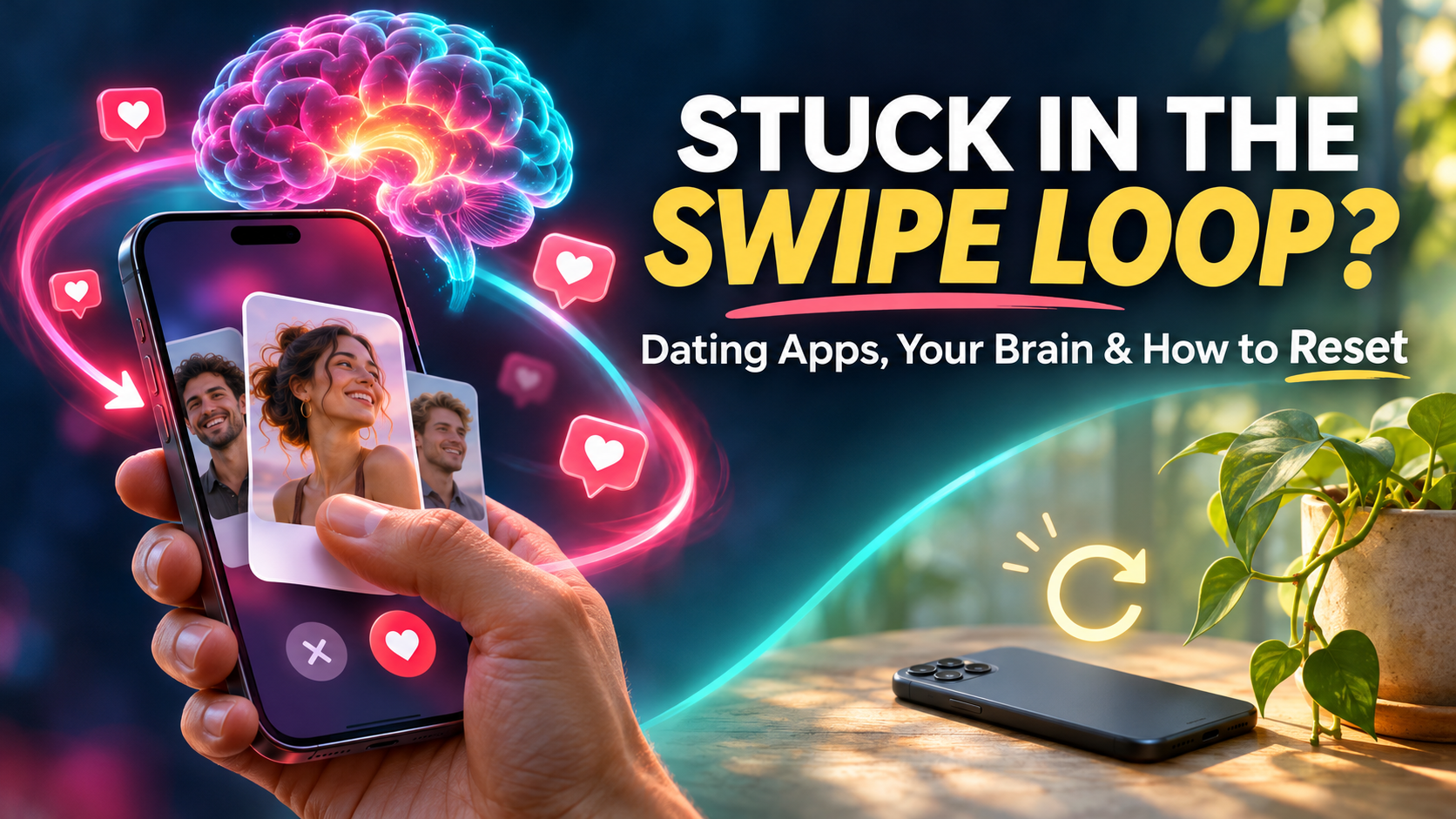
A wellness guide to digital minimalism, nervous system regulation, and breaking the swipe habit · About an 11-minute read
Key takeaways
Dopamine is your brain's anticipation signal, not its pleasure chemical. It responds most strongly when a reward is possible but uncertain, which is exactly how a swipe feels.
Dating apps run on a variable reward schedule, the same reinforcement pattern that makes slot machines hard to walk away from.
A 2026 meta-analysis of 27 studies found the strongest link between dating apps and mental health is compulsive use and loss of control.
The fix isn't willpower. It's making rewards predictable, calming your nervous system, and giving your brain a better offer.
You don't have to delete everything. A 7-day reset and a few re-entry rules can turn swiping from a compulsion back into a tool.
You open the app "just for a minute." Twenty-five minutes later you've swiped through 150 faces, matched with two people you won't message, and you feel strangely flat: a little wired, a little empty, and somehow more single than when you started.
That isn't a character flaw. It's a learning system in your brain doing exactly what it evolved to do, inside a product that's very good at activating it. Once you understand the loop, you can step out of it.
How do dating apps affect your brain?
Short answer: Dating apps engage the brain's dopamine-driven reward-learning system. Each swipe carries a small, unpredictable chance of a match or message, and dopamine neurons are especially responsive to rewards that are uncertain. Over time, this variable reward pattern can turn swiping into an automatic habit loop that leaves many users feeling drained, anxious, or less satisfied, even when the apps "work."
Let's unpack what that actually means, and what to do about it.
Dopamine isn't the "pleasure chemical." It's the "maybe" chemical.
Pop culture calls dopamine the feel-good hormone. Neuroscience paints a more interesting picture.
Over decades of research, University of Cambridge neuroscientist Wolfram Schultz showed that dopamine neurons behave like prediction machines. When something turns out better than expected, they fire in a burst. When a reward arrives exactly as predicted, they barely respond. When something is worse than expected, their activity dips below baseline. Scientists call this the reward prediction error, and it's how your brain learns what's worth repeating.
A landmark 2003 study in Science by Fiorillo, Tobler and Schultz added a twist. Dopamine neurons also showed a slow, building ramp of activity tied to uncertainty itself, strongest when a reward was about as likely as a coin flip. In other words, the brain gets especially activated by "it might happen."
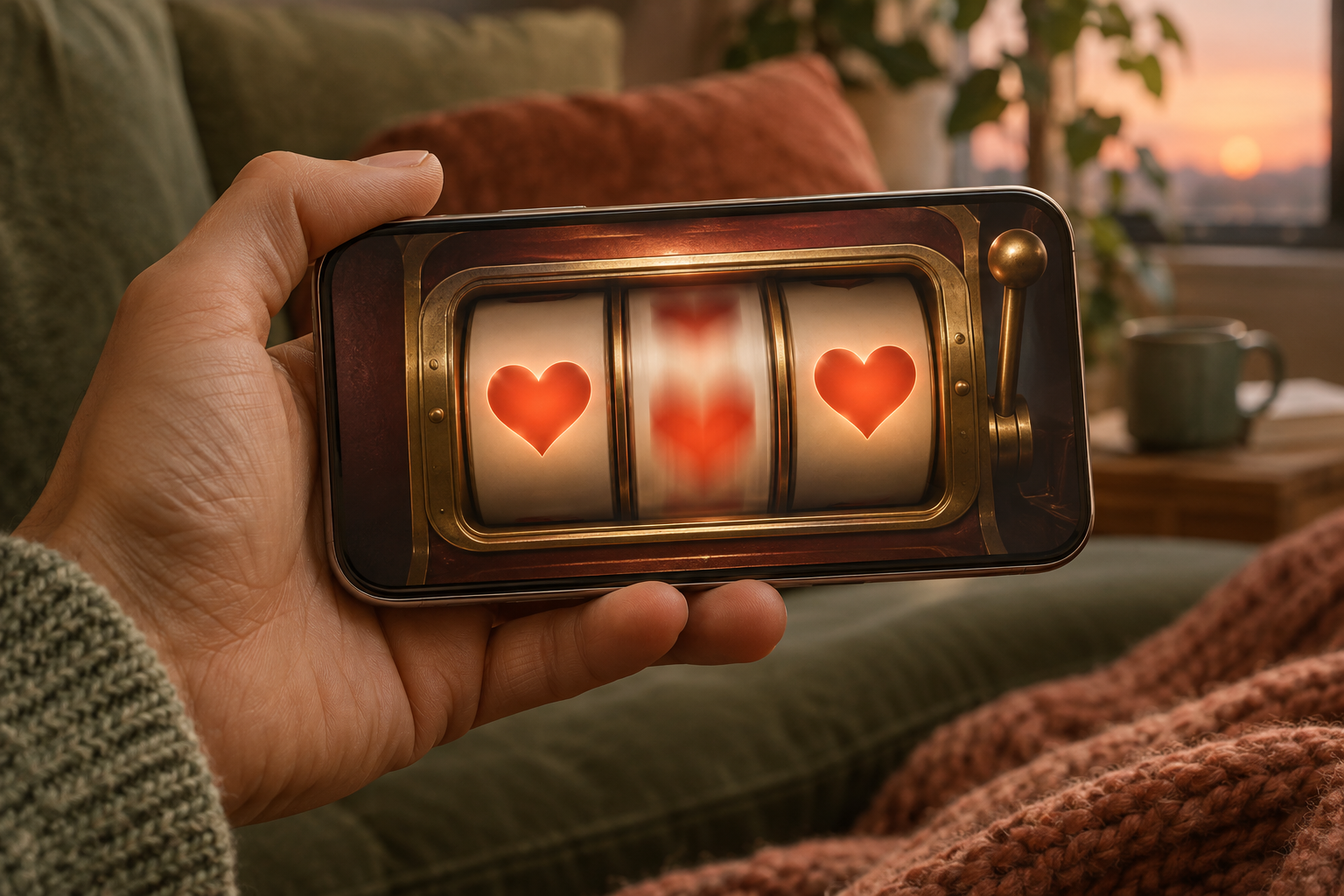
Stanford psychiatrist Anna Lembke, author of Dopamine Nation, describes the practical upshot: with gambling-style rewards, the anticipation can be more compelling than the payoff itself. If you've ever felt the jolt of a new-match notification and then never opened the chat, you know this feeling.
Now look at a dating app through that lens. Every profile is a tiny lottery ticket. Most swipes lead to nothing. Occasionally, and unpredictably, you get a match, a like, or a message. Those are almost exactly the conditions dopamine circuitry is most sensitive to.
The anatomy of the swipe loop
Psychiatrist and neuroscientist Judson Brewer, who runs a habit-change research lab at Brown University, breaks every habit into three parts: a trigger, a behavior, and a reward. Once a loop is learned, it runs largely on autopilot, often before the thinking part of your brain gets a vote.
Here's how that maps onto dating apps:
Loop stage |
What it looks like on a dating app |
What your brain learns |
|---|---|---|
Trigger |
Boredom in line, loneliness at 11 p.m., a notification, a rough day |
"This feeling means open the app." |
Behavior |
Opening the app, swiping, refreshing, checking who liked you |
"Swiping is what we do when we feel this way." |
Reward |
An occasional match or message, a hit of validation, a moment of distraction |
"It worked once. Try again." |
Two design features make this loop especially sticky:
Variable rewards. Behavioral psychologists call it a variable-ratio schedule: a reward arrives after an unpredictable number of actions. It's known for producing some of the most persistent behavior of any reward pattern, and it's the engine behind slot machines.
Layered uncertainty. Dating apps stack several "maybes" on top of each other. Will they match? Will they reply? Will it turn into a date? Each layer is another reason to check again.
Endless profiles, push notifications that arrive in unpredictable bursts, and celebratory "It's a match!" screens amplify the effect. None of this means dating apps are uniquely bad; much of modern tech works this way. It means your brain is responding normally to an environment engineered for engagement.
What the research says about swiping and wellbeing
The science on dating apps and mental health is still young, but it's growing fast and the picture is getting clearer.
The biggest review so far points to compulsive use. In 2026, researchers Cela and Wood published a systematic review and meta-analysis in Communications Psychology that pooled 27 studies and more than 21,000 participants. They found a small-to-moderate overall association between swiping-based dating apps and poorer mental health.
The strongest link was with behavioral dysregulation, meaning compulsive use and loss of control, followed by body dissatisfaction and appearance anxiety. The authors were careful to note that most of the studies were cross-sectional, so they can't prove the apps cause these problems, and that the findings "do not imply uniform or generalized psychological harm."
Excessive swiping is the pressure point, not the app itself. A 2023 University of Vienna study of 464 young dating app users, published in Telematics and Informatics, found that more frequent use was tied to excessive, compulsive swiping. That swiping, in turn, was linked to comparing yourself to people who seem "out of your league," fear of being single, and partner choice overload. Researcher Jörg Matthes likened heavy use to compulsive gambling, warning that "excessive use can have negative psychological effects on people."

Loneliness raises the stakes. Research led by Kathryn Coduto in the Journal of Social and Personal Relationships found that lonely people who prefer online interaction were the most likely to use dating apps compulsively, and that compulsive use predicted real-life fallout like missing class or work.
Burnout is the norm, not the exception.
In Match and the Kinsey Institute's 2025 Singles in America study of about 5,000 U.S. singles, 47% said they felt burned out by dating and 54% said modern dating leaves them emotionally drained.
A 2024 Forbes Health/OnePoll survey of 1,000 recent app users found 78% felt dating app fatigue at least sometimes, and the average user spent 51 minutes a day swiping.
Pew Research Center found that 55% of recent online daters felt insecure, at least sometimes, about how few messages they received, while women were far more likely than men to feel overwhelmed by too many.
The pattern across these findings is consistent: problems tend to show up when use becomes compulsive, when you're swiping to regulate a feeling rather than to meet a person.
Your nervous system on dating apps
This is where a wellness lens is especially useful. A swipe session isn't just a mental event. It's a physical one.
Rejection registers as pain. In a well-known 2003 Science study, UCLA researchers Naomi Eisenberger and Matthew Lieberman found that being excluded, even in a simple online ball-toss game with strangers, activated brain regions involved in the distress of physical pain. Dating apps can deliver dozens of micro-rejections a day: unreturned likes, unanswered messages, ghosting mid-conversation.
Uncertainty keeps you on alert. Waiting for a reply you can't predict keeps your stress response subtly switched on. Many people describe the result as "tired but wired": restless, distracted, compelled to check, and unable to fully relax.
Late-night swiping costs sleep. Scrolling in bed combines bright screens, emotional arousal, and the "just one more" pull of a variable reward, a reliable recipe for staying up later than you meant to.
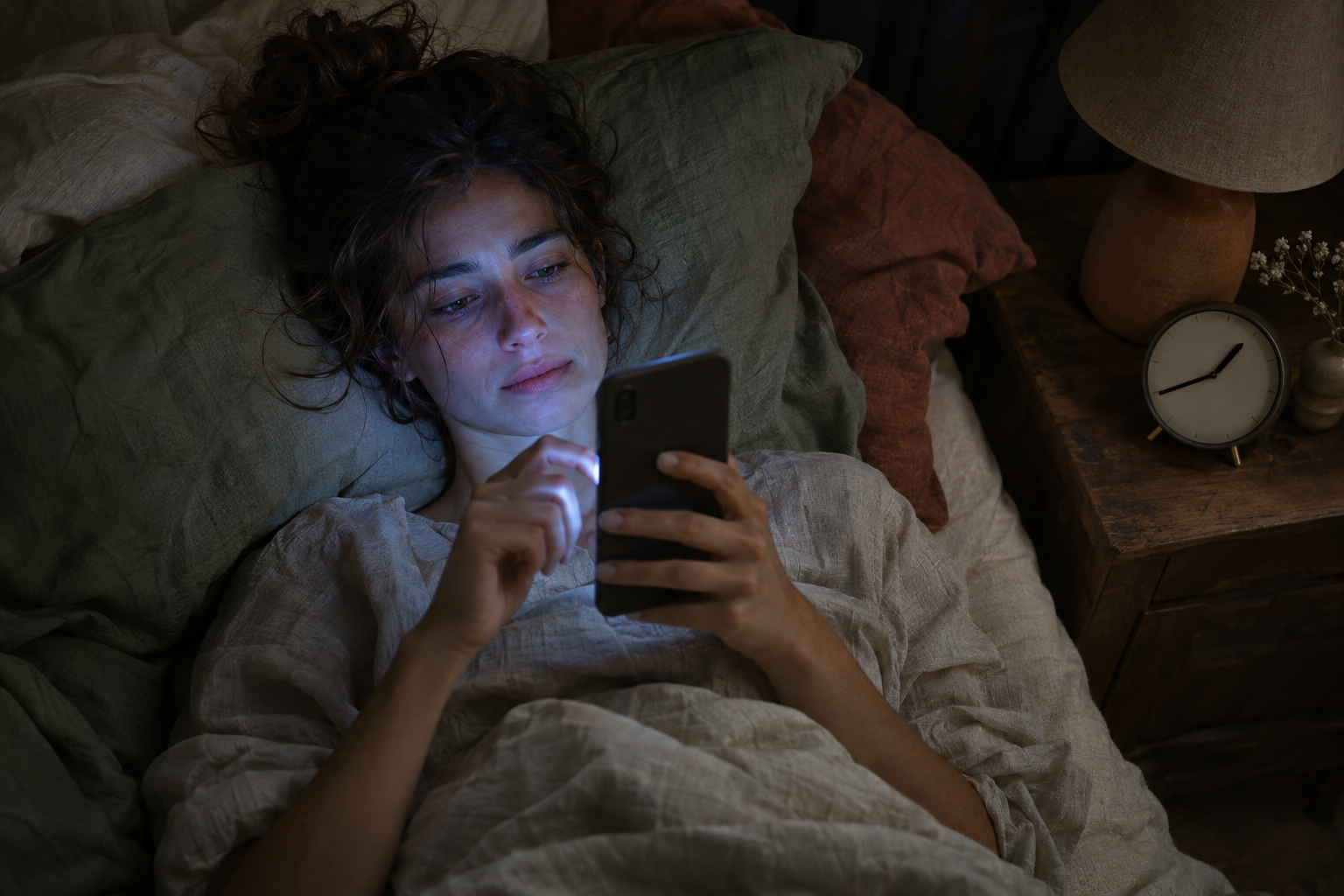
Signs your swipe habit is dysregulating you
You open the app automatically when bored, anxious, or lonely, often without deciding to.
You feel a jolt of anticipation at notifications, then flatness or irritation afterward.
You collect matches but rarely message them or meet up.
You've deleted and reinstalled the app more than once.
You feel worse about your looks, your worth, or your prospects after a session.
Swiping eats into your sleep, your work, or time with people you already know.
If several of these land, you're not broken. Your loop has simply drifted from tool to coping mechanism. That's exactly what a reset is for.
How to reset: a 7-step dating app dopamine detox
Think of this the way wellness experts approach a social media detox: not as punishment, but as a chance for your reward system and your nervous system to recalibrate.
1. Map your loop before you change it
Brewer's research suggests willpower is a weak tool against habits, because the loop fires faster than your good intentions. Awareness works better. For three days, before or after each session, jot down: What was I feeling right before I opened the app? What did I do? How did I actually feel 10 minutes later? Be specific. Many people discover the "reward" feels far less rewarding than their brain promised, and that realization alone starts to weaken the loop.
2. Turn off every notification
Notifications are external triggers that pull you back in on the app's schedule, not yours. Turn them all off: sounds, banners, badges. One dater profiled in Rosalind Franklin University's Helix magazine, after a stretch of swiping for as long as eight hours a day, returned to the apps only with self-imposed rules, and the first was no notifications of any kind.
3. Choose your reset: full pause or structured break
Full pause (best if you feel hooked): Lembke recommends at least four weeks away from a compulsive app so the brain's reward pathway can rebalance. Delete the apps rather than just logging out, and pause or hide your profile.
Structured break (best if you're mildly fatigued): Take one full week off, then return with the rules in steps 4 through 7.
Expect the first few days to feel restless. That itch is the habit loop looking for its usual reward, and it typically fades.
4. Make the reward predictable
Unpredictable rewards drive compulsion; predictable ones are much easier to walk away from. If you go back, swipe only inside a fixed window, say 20 minutes at 7 p.m. three days a week, with a timer running. Batch your replies in that same window. When the "maybe" happens on a schedule, much of the slot-machine pull disappears.
5. Regulate your body before and after
Treat swiping like any other mildly activating activity, and bookend it.
Before: Check in with yourself. If you're lonely, anxious, or coming off a hard day, you're swiping to soothe, which is when the loop grips hardest. Reach for another tool first: a walk, a call, a shower.
After: Try two or three rounds of the physiological sigh: a double inhale through the nose, then a long, slow exhale through the mouth. In a 2023 Stanford study published in Cell Reports Medicine, five minutes a day of this "cyclic sighing" improved mood and eased anxiety more than mindfulness meditation over a month.
Always: Keep the app out of your bed, and skip swiping in the hour before sleep.

6. Give your brain a "bigger, better offer"
Brewer's approach doesn't ask you to white-knuckle cravings. It asks you to get curious about them, to notice what the urge actually feels like in your body, because, as he puts it, "curiosity feels better than craving." Then fill the time you've freed with rewards that are slower but deeper: a run club, a pottery class, dinner with friends who might know someone, volunteering. Offline connection gives your reward system something real to learn from.
7. Re-enter with intention
When and if you return, write down your rules first:
Purpose: What am I actually looking for? Swipe right only on profiles that fit it.
Quality over quantity: Cap yourself, for example at five new likes per session, and match only with people you'd genuinely message.
Move it offline: Aim to suggest a short, low-stakes meetup within a week of a good conversation, so the app stays a doorway rather than a destination.
Check in monthly: Is this adding to my life? If the warning signs creep back, take another break.
Researcher Kathryn Coduto sums up the philosophy neatly: "Managing your expectations and regulating your use are important for successful app use."

Your 7-day reset at a glance
Day |
Focus |
Practice |
|---|---|---|
1 |
Awareness |
Map your trigger, behavior, and reward every time you feel the urge to swipe. |
2 |
Remove triggers |
Turn off notifications; move the apps off your home screen or delete them. |
3 |
Pause |
No swiping. Notice the urge, name it, and breathe through it. |
4 |
Regulate |
Five minutes of cyclic sighing; phone out of the bedroom tonight. |
5 |
Better offers |
Plan one in-person social activity for the coming week. |
6 |
Reflect |
Review your notes: what were you really seeking when you swiped? |
7 |
Decide |
Extend to a four-week pause, or write your re-entry rules. |
Should you quit dating apps for good?
Not necessarily. Dating apps help a lot of people find each other. Pew Research Center found that about one in ten partnered U.S. adults met their current partner on a dating site or app, and slightly more users describe their experience as positive than negative.
The goal of a reset isn't to shame the tool. It's to change your relationship with it, so you're using the app with intention instead of the app using your reward system. For some people, that means a permanent break. For others, it means 20 focused minutes, three times a week, with notifications off. Both are valid wellness choices.

FAQ: Dating apps and dopamine
Are dating apps addictive? Dating app use isn't a formally recognized addiction, but the apps rely on the same variable reward pattern behind gambling, and research links heavy use to compulsive swiping and loss of control. For most people, it's more accurate to think of it as a habit loop that can become compulsive, especially during loneliness or stress.
Why do I feel worse after swiping? Dopamine drives anticipation, not lasting satisfaction, so the buzz fades fast. Add frequent micro-rejections, comparison with idealized profiles, and choice overload, and many people end a session feeling flat, anxious, or less confident.
How long does a dating app dopamine detox take? Stanford psychiatrist Anna Lembke recommends at least four weeks away from a compulsive app for the reward system to reset. Many people notice the urge to check easing within the first week.
How much time on dating apps is healthy? There's no official limit, but research suggests problems cluster around excessive, compulsive swiping rather than use itself. A fixed, time-boxed window, such as 15 to 20 minutes a few times a week, keeps rewards predictable and use intentional.
Can I reset without deleting the apps? Yes. Turning off notifications, swiping only in scheduled windows, capping daily likes, and never swiping in bed all reduce the variable-reward pull while keeping the app available when you want it.
The bottom line
The swipe loop works because your brain is doing its job: chasing uncertain rewards, learning fast, and automating whatever seems to pay off. Dating apps simply deliver those conditions on demand. You can't redesign the app, but you can redesign your relationship with it: notice the loop, remove the triggers, make rewards predictable, calm your nervous system, and invest in the slower, richer kind of connection no feed can give you.
This article is for general wellness information and isn't a substitute for professional care. If dating app use is affecting your mood, sleep, or daily life, or you're struggling with loneliness or anxiety, consider talking with a licensed mental health professional.
Sources
Cela & Wood (2026). Systematic review and meta-analysis of swiping-based dating app use, Communications Psychology. Summary: News-Medical
Thomas, Matthes et al. (2023). Telematics and Informatics. Summary: HealthDay
Coduto, Lee-Won & Baek. Journal of Social and Personal Relationships. Summary: PsyPost
Fiorillo, Tobler & Schultz (2003). Discrete coding of reward probability and uncertainty by dopamine neurons, Science: PDF
Schultz (2016). Dopamine reward prediction error coding, Dialogues in Clinical Neuroscience: PMC
Lembke, Dopamine Nation, as discussed in Rosalind Franklin University, Helix
Brewer, J. The science behind bad habits and how to break them: Psychology Today; What is the habit loop?
Match & The Kinsey Institute (2025). 14th annual Singles in America: Match; Fast Company SA
Forbes Health/OnePoll (2024) dating app fatigue survey: Global Dating Insights
Pew Research Center (2023). Key findings about online dating in the U.S.: Pew
Eisenberger, Lieberman & Williams (2003). Does rejection hurt? Science: DOI
Balban et al. (2023). Brief structured respiration practices enhance mood and reduce physiological arousal, Cell Reports Medicine: DOI




Write A Comment